At Kermit’s Table, Part 1
A creative spirit of wine releases his first novel—set in France’s vineyards
Kermit Lynch is a Renaissance man of the wine world. In the decades after he opened his first wine shop just outside of Berkeley, Calif., in 1972, he became one of America’s most influential and pioneering wine importers—championing terroir-driven wines from small producers in France (and later Italy) before they were cool.
His 1988 book Adventures on the Wine Route is the classic of the modern French vigneron movement. Then, for a decade beginning in 2010, he crooned on five bluesy CDs with a Nashville record label.
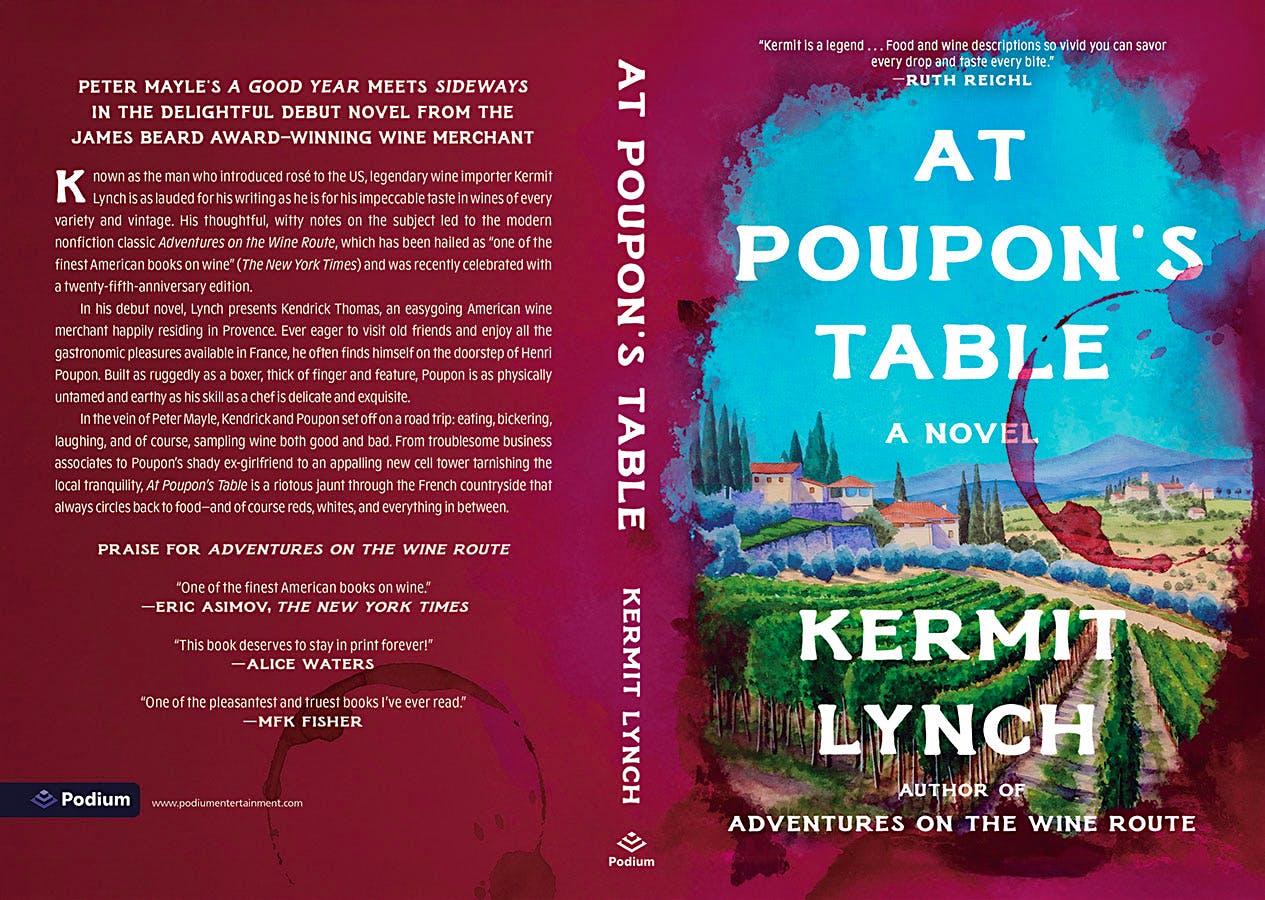
Now, at 83 and just a few years into retirement, Lynch lives on a hillside in Provence that’s a stone’s throw from the coastal Bandol appellation. At the end of September, he is releasing his first novel, a paean to Provençal life, food and wine in general, called At Poupon’s Table (Podium Publishing).
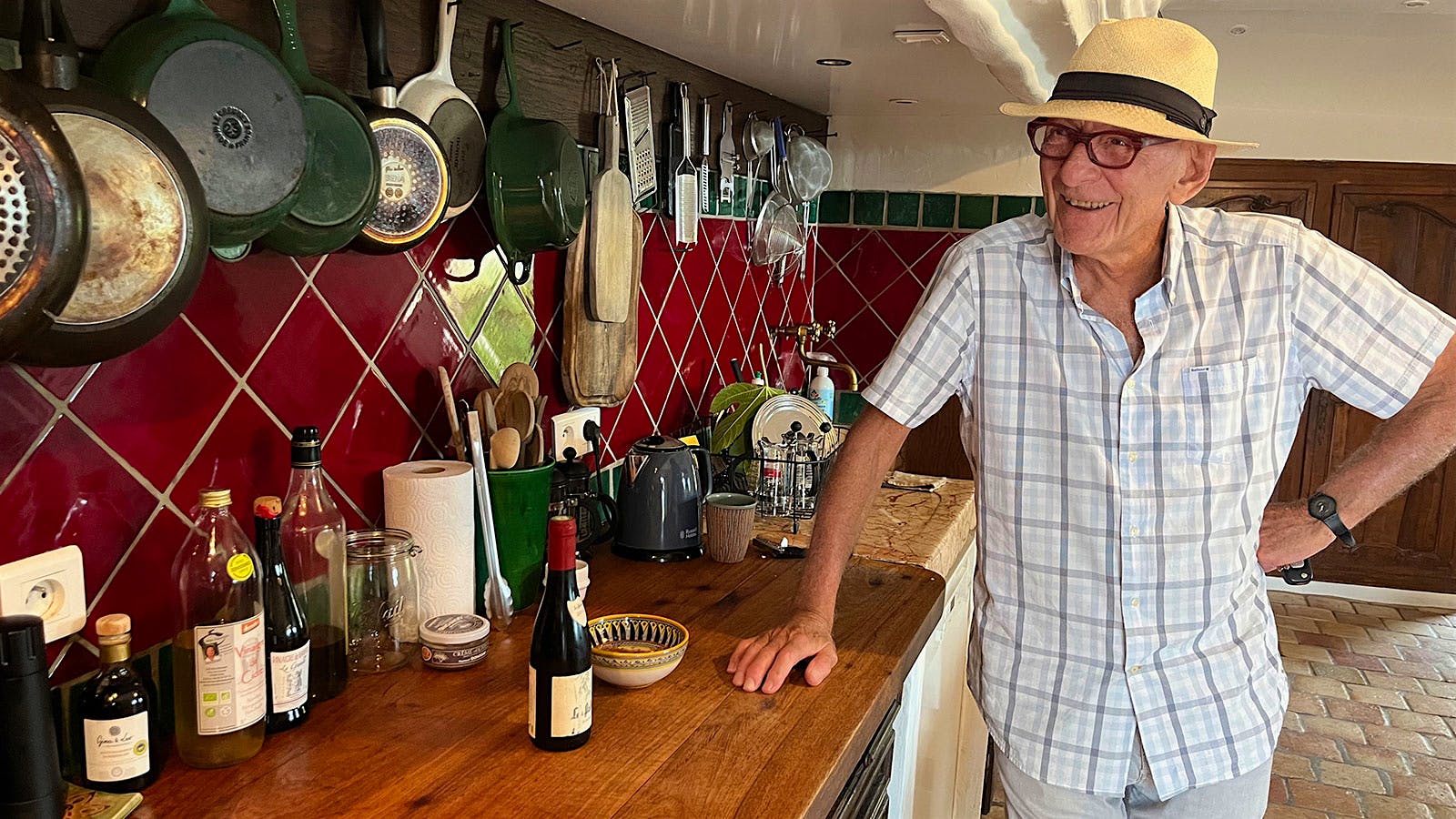
I recently met with Lynch at his 19th-century farmhouse, which he bought four decades ago and which has recently become his full-time residence, to chat about his novel, his career path and much, much else—from the state of French dining to the state of wine cellars today.
Kermit Lynch: I’ve always been interested in fiction, and part of the inspiration for this book came from a book that Lulu Peyraud [late matriarch of Domaine Tempier] gave me 40 or 50 years ago. It was the memoir of the French-Provençal film actor Charles Blavette [Ma Provence en Cuisine, 1961]. He wrote about making the films around here and about everyday life. The life revolved around food and drink, and I loved that aspect. So I started thinking about writing a book about life in Provence today. And I thought it had to be a novel. That way I could invent things and not always be tied to the truth. Liberty!
Definitely. I'm still, for lack of a better term, chairman of the board, but I have almost nothing to do with the day-to-day business, and that’s the way I want it. I’m travelled out. The president of the company, Dixon Brooke, is so talented and a much smarter businessman than I ever was.
I read a couple of books by the German religious scholar Gisela Kreglinger about wine and the Bible. And it really struck me how, in the Old Testament, life was olive oil, wheat and wine grapes and how they gave thanks to God for wine. They appreciated wine so much as a gift from God. And I wanted some of that feeling in my book, too. Not religiously, because that’s not me. But this attitude of wine as a joy and a blessing.
Wine is a necessity of life. I’m not at all one of these people who figures out what kind of lemon is in the nose of a wine or what kind of cherry that is.
It’s the role of wine and food in one’s life, and how that can be a thing of beauty.
Well, that might have been more to please the publisher than anything.
I pulled from a lot of things that happened in my life. I pulled from a lot of people.
(Laughs) Well, that’s all me. Kendrick is selling my message in there. What makes a beautiful wine?
Harmony is important. And individuality. I look for a wine that smells and tastes like wine. When you start doing new oak, you no longer have the taste of wine. Another thing I want to point out—and people will probably think I’m crazy—is that, in this day and age, almost all cellars are sterilized. They don’t want any mold to grow. And to me, that was a big part of a wine’s taste in these old cellars that smelled incredible, with that freshness of the mold and the dripping water. Like [Chablis’ Domaine] Raveneau, one of the most beautiful cellars I’ve ever seen—all covered with mold. Now that so many cellars are sterilized, the wines taste fruity to me. I mean if you want fruity, great, go buy fruit juice and save a lot of money.
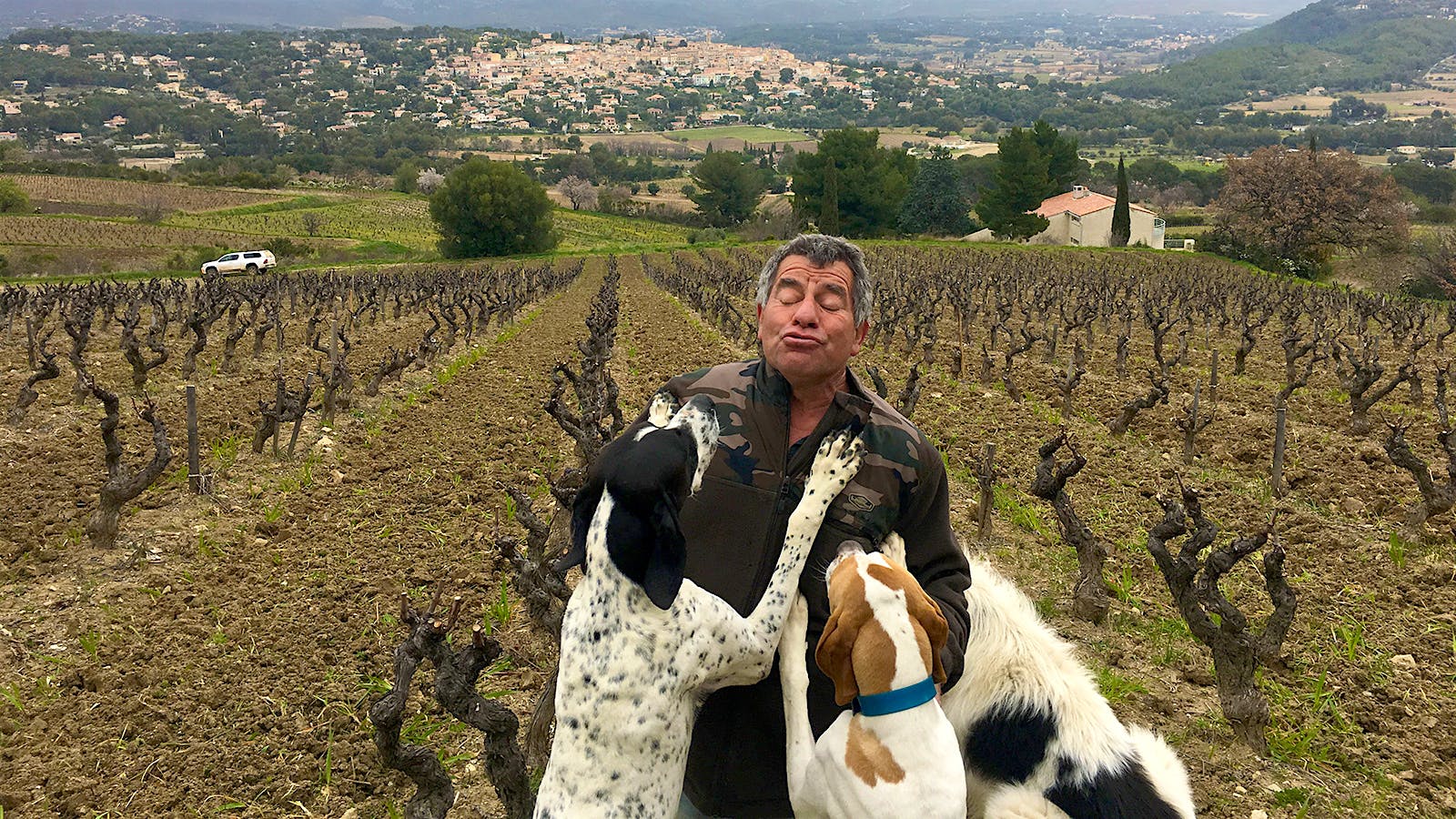
Yeah! If you wanted a photo of Poupon, it would be Alain—this Provençal guy who is an ex-boxer and hunter. He’s the model for the Provençal look and attitude. But how much is his life? Very little, really. And also, Alain taught me to say merde. Merrrrdddde! (laughs) Because it’s every other word he says.
I’ve known a lot of good cooks in my career. When we get together around here, we talk about food, and we pass on ideas on how to improve.
(Laughs) You don’t think, if I wrote a book, I wouldn't make my protagonist a better lover than I am?
Yes, restaurants in France. London is now a paradise. New York is a paradise. Here, I don’t know. I read in a French magazine that today in France 80 percent of the restaurants don’t cook anymore. They are all microwave, frozen, canned and whatnot—of course that makes them lousy. Now I don’t go anywhere until I have a recommendation.
One of the most popular restaurants around here is McDonald’s—it’s always busy. I hadn’t had a McDonald’s hamburger since my first year of college in Fresno. I tried one here recently out of curiosity, and I just couldn’t eat it.
I don’t know. I do like to write. You called me a Renaissance man—someone else could say dilettante. My voice has aged, and I can’t sing like I used to—so no more CDs … .
I have another book in mind that doesn’t have a single wine in it. It’s a story from my family about World War II: My father, who was an athlete and evangelist, became a conscientious objector. [He went AWOL a couple of times on U.S. soil and was thrown in the brig, but finally made peace with his commanding officer by agreeing to organize an Army softball team.] And that was not well looked upon during World War II—not by his family, not by his wife. Not anybody. I mean, you weren’t a man if you wouldn’t fight. And that story really struck me.
Not at all. I’m here now. I came here in 2021 during COVID and those huge forest fires in California. I was just going to come for a short period. But when I left California, the sky was thick orange—solid orange. You couldn’t see anything.
And when I got here, I didn’t feel claustrophobic anymore. Here, it’s sort of a country life, even though there’s a village not far away, and a big sky. It was this physical and psychological feeling all at once of this kind of openness. I’ve lived here ever since.
Read Part 2 of this interview at Robert Camuto Meets… on Oct. 7 and learn more about Lynch’s road to wine and his influential career.
When traveling in the Southern Rhône, Lynch (like many of our editors) favors the 30-seat restaurant L’Oustalet, owned by the Perrin family of Château de Beaucastel in Châteauneuf-du-Pape and chef Laurent Deconinck. “It’s not pretentious, one is well served and the cuisine is outstanding,” he explains.
For menus, hours and reservations, visit www.loustalet-gigondas.com.
When it comes to eating Provençal-style in a relaxed country setting, Lynch’s go-to restaurant is the Relais du Castellet in Fontvieille, about 5 miles northeast of Arles. “I had the best octopus of my life there,” enthuses Lynch.
For menus, hours and reservations, visit lerelaisducastelet.fr.