Italy’s New Normale
The reopening of the country's restaurants has come with a chill vibe—and no reservations required
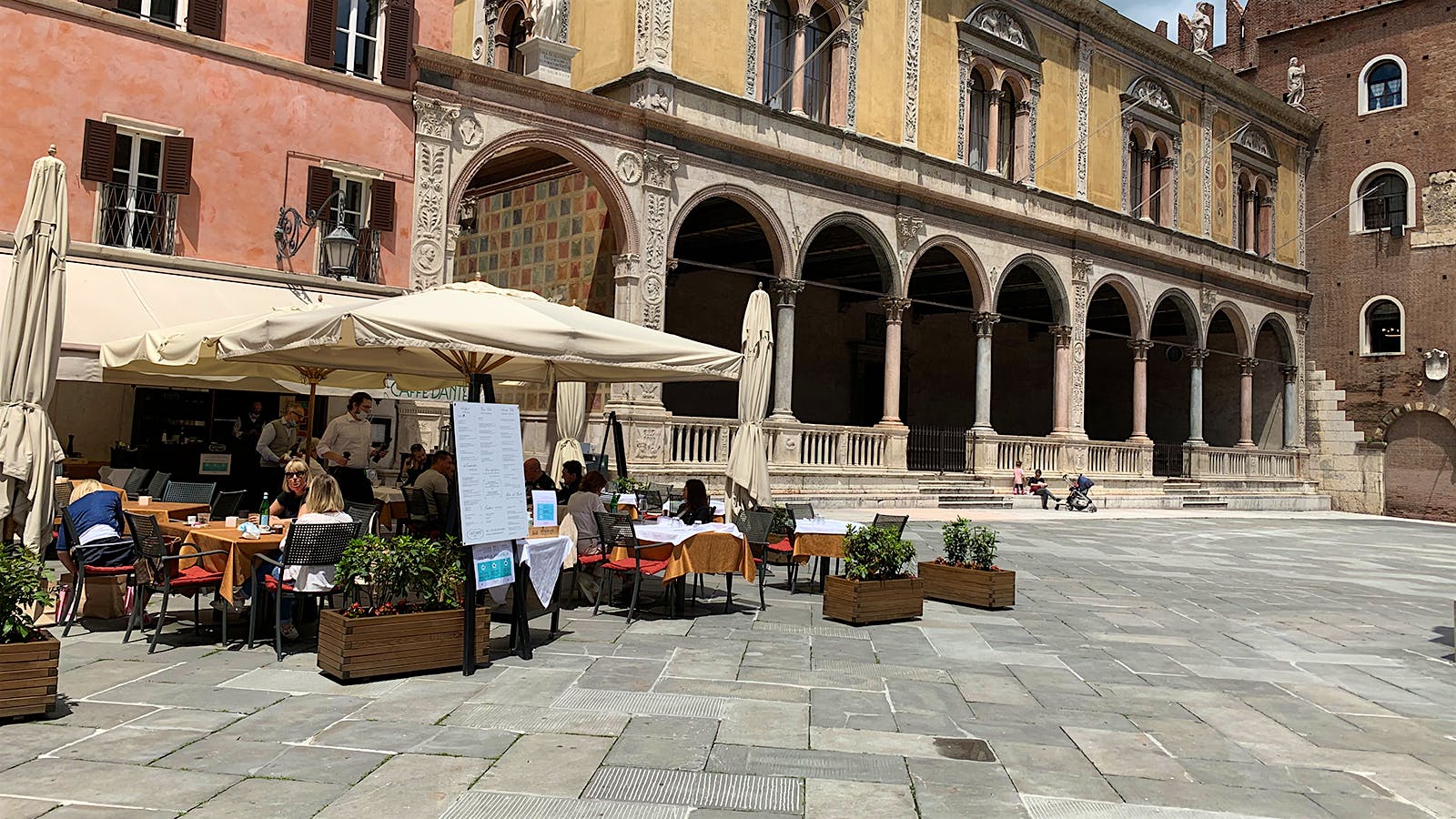
It’s nearly summer, and things look almost back to normale in Italy these days. Many Italians are out in the piazzas sipping colorful spritzes at outdoor cafes; dining al fresco in restaurants, pizzerias and trattorias, or strolling with scoops of gelato.
Of course, this June is different. The tourist throngs—make that tourists in general—are gone. After weathering one of the world’s earliest and harshest COVID-19 outbreaks, Italy reopened about a month ago with state-mandated protocols, like the very un-Italian concept of social distancing, still in place. Face masks are required inside businesses except when customers are seated at a restaurant or bar table. (I’ve found that masking is more or less practiced indoors. Often less.) Lombardy, home to the bustling city of Milan and the hardest hit of Italy’s regions, is the only one still requiring masks outdoors, for the moment.
Less than two weeks ago, I returned to my home in Verona after three months of lockdown in France, caught behind a border that had been closed. Despite the inconveniences, I am savoring a slower-paced and less crowded Italy with dwindling numbers of coronavirus infections.
In the past week, my wife and I have been to more than a half-dozen restaurants and cafes and, except for the masked servers, it’s certainly been a more laid-back experience than is usual this time of year. There’s a lot more room to stretch out as there’s more space between tables, servers are attentive and, in general, no reservations are needed.
“The customers who are coming out are more relaxed,” says Gianpaolo Spinelli, manager of Verona’s historic Caffè Dante Bistrot, owned by the Tommasi wine family and situated on one of Verona’s most picturesque piazzas.
Since it reopened in late May with half its 20-member staff, the restaurant is offering a shorter menu that changes weekly. It’s printed on antimicrobial paper and also available by scanning a QR code with a smartphone.
After three months of il lockdown, says Spinelli, his Veronese customers were ready for something different: “The first week we were open we sold out all our bottles of Bollinger and Dom Perignon. Things people don’t drink at home.”
Of course, not everyone is celebrating. Though more than 95 percent of restaurants have reopened, according to Italy’s primary restaurant association, La FIPE, they are doing less than half their usual business.
That void is primarily from a lack of tourism, which normally brings in about 62 million visitors a year, according to the U.N. World Tourism Organization. In Verona, for example, one of the wine world’s biggest exhibitions, Vinitaly, held in April, was pushed off to next year, as was the city’s popular summer opera festival.
As an American who lives here, I have been guided by the numbers in my decisions about traveling and dining out. Italy is now registering about 200 new cases of COVID-19 per day—most of them in Lombardy. In the 5 million–population Veneto region, which includes Verona and Venice, on any given day last week, new cases ranged from zero to 13. For now, I’ll take those odds.
Business may start improving from this week on, as more European countries open their borders to each other. In July, Europe may begin to open to visitors from countries farther afield, but news reports indicate that nonessential travel will likely remain prohibited from the United States and other countries where new COVID-19 cases continue to climb.
“I have American clients who wrote me to say, 'This year, I can’t come.’ We’ll miss them,” says Spinelli, adding with a laugh, “They drink a lot of Amarone.”
Before this year, Verona’s Antica Bottega del Vino, a temple of wine for northern Italy and a Wine Spectator Grand Award winner since 2004, had closed only once in its 130-year history—for World War II.
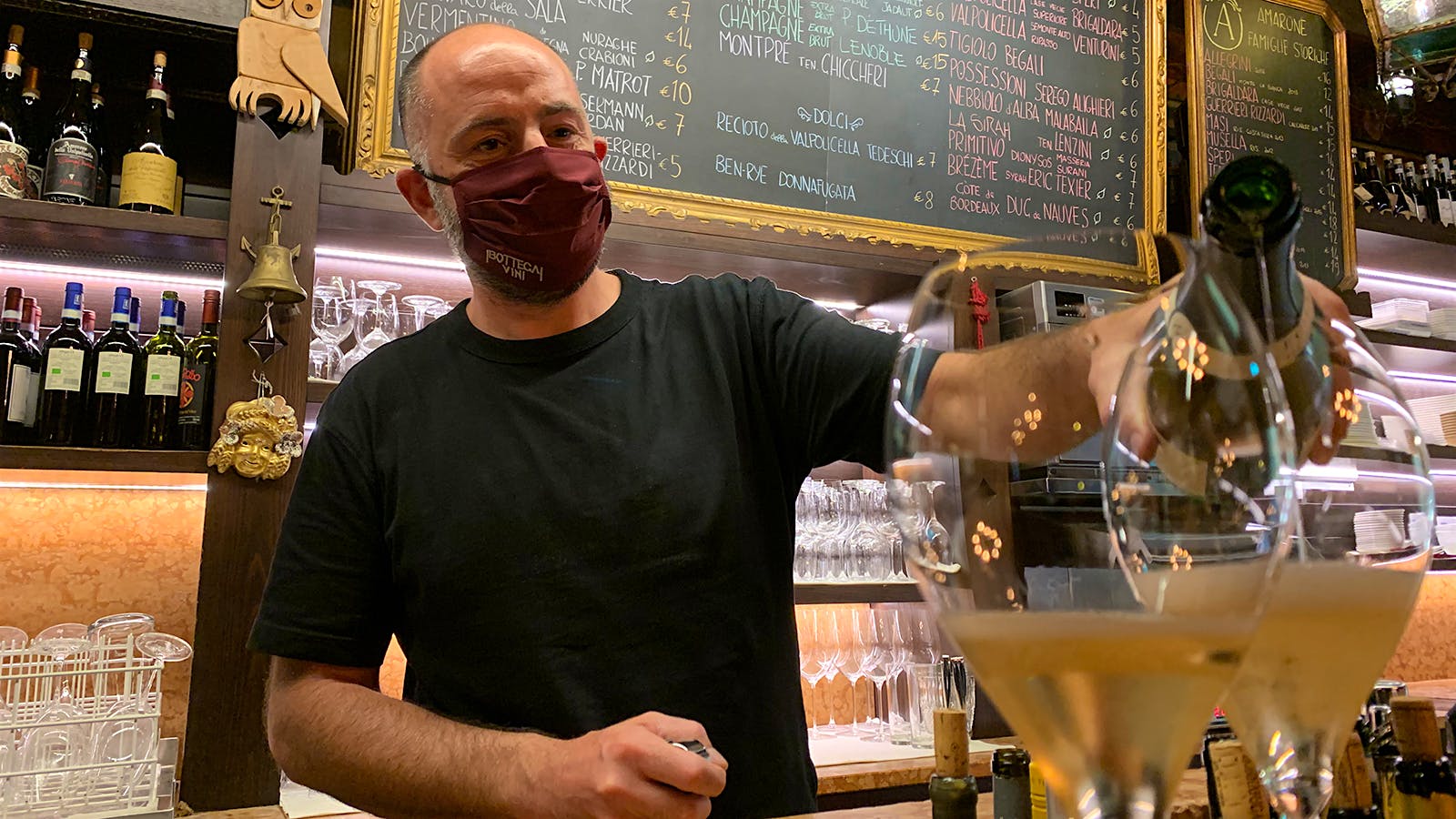
Since the wine bar reopened on May 18, the first day Italy allowed restaurants to receive customers, Bottega del Vino has cut its number of seats from 80 to 50, along with more than half its staff. Its 4,200-label wine list was transferred to an electronic tablet that gets swabbed down between uses. The entire restaurant is disinfected with ozone gas between services. At first, there were few to no customers, but general manager Luca Nicolis told me he feels a responsibility to keep the doors open.
“We are the first visible sign of the country restarting. We have to be open, to show it is safe to come out,” says Nicolis, a tall, charismatic Italian whose instinct is to throw his arms around his returning customers as they come in the door. These days, he restrains himself—most of the time. “For the last 10 years, we made money. This year, we won’t make anything, and that’s OK. Our main goal is to keep workers.”
Nicolis says that in the past month a new local clientele has been showing up at Bottega, which is owned by a group of Amarone-producing families. “People over 40 aren’t going out that much,” he notes. “What surprised me is that we have younger people coming, and they are spending more money.”
He has also been surprised by a shift in drinking habits. “They are drinking Champagne and a lot of Pinot Noir—Pinot Noir either from the Alto Adige or Burgundy,” says Nicolis. “And they are coming in very well-prepared, with knowledge about what they want to try.”
“They must have spent a lot of time during lockdown looking at sommelier posts on social media and studying wine,” he adds. “I’ve been very impressed.”
He pulls a mask bearing the Bottega logo up over his face, gets up from the table we’ve been sitting at and goes behind the bar to pour glasses of Champagne for a toast.
“We hope,” he says, “this could be the start of something new.”